
Most construction owners have the same fear:
"If I step away, everything will fall apart."
So they don’t step away.
They take half-vacations – answering texts between activities, reviewing estimates at night, calling the office "just to check in."
The problem with that approach is simple:
You never actually find out if your business can run without you.
In this blog, I want to walk you through a different way of thinking about vacation – as a deliberate delegation experiment.
We’re not just trying to get you rest.
We’re trying to learn how your business behaves when the owner steps back, and then coach from what we learn.
Why Most Owners Never Really Test Their Systems
When you’re the central problem-solver in your company, you’re always one phone call away from being right back in the chaos.
It feels responsible.
You tell yourself:
- "The team needs me."
- "Clients expect me."
- "If something goes wrong and I’m not there, that’s on me."
But here’s what’s actually happening:
- The team never gets a fair chance to run the business without you.
- You never get clean data on which systems hold and which break.
- You train everyone to assume that you will always swoop in.
From a coaching perspective, that means we’re trying to improve systems we’ve never really stress-tested.
The vacation delegation experiment fixes that.
The Vacation Delegation Experiment: A Playbook
Here’s how we turn a vacation into a structured experiment instead of a hopeful break.
1. Prep: Name the Critical Functions
Two to four weeks before your time away, we sit down and list:
- The decisions you usually make.
- The conversations you usually hold (with clients, subs, suppliers, team).
- The problems you usually solve when things go sideways.
We’re building a clear picture of where you’re a bottleneck.
2. Design: Create Delegate Worksheets for the Team
We build simple worksheets for your key people that ask:
- "What is your role while I’m gone?"
- "What decisions are you authorized to make without me?"
- "What decisions should you pause until I’m back?"
- "If something goes wrong, what’s your first move?"
We’re not just telling them "step up." We’re defining what "stepping up" looks like.
3. Communicate: Set Expectations With the Team
You sit down with the team and say plainly:
- "I’m going to be off for these days."
- "Here’s what I’m trusting you to own."
- "Here’s how I want you to handle problems."
- "Here’s when you should contact me, and when you shouldn’t."
We’re drawing a line between genuine emergencies and normal business difficulty.
4. Execute: Actually Step Back
This is the hardest part.
You:
- Do not answer every text instantly.
- Do not quietly review every email.
- Do not jump in at the first sign of discomfort.
You stay available for true emergencies, but otherwise, you let the experiment run.
5. Debrief: What Happened While You Were Gone?
When you return, we hold a dedicated debrief session with:
- Your own observations.
- The team’s stories.
- The worksheets they filled out.
We’re asking:
- Where did things go better than expected?
- Where did things wobble?
- Where did the team show unexpected strength?
- Where did systems clearly fail?
Now we have real data.
What You Learn From a Good Vacation Experiment
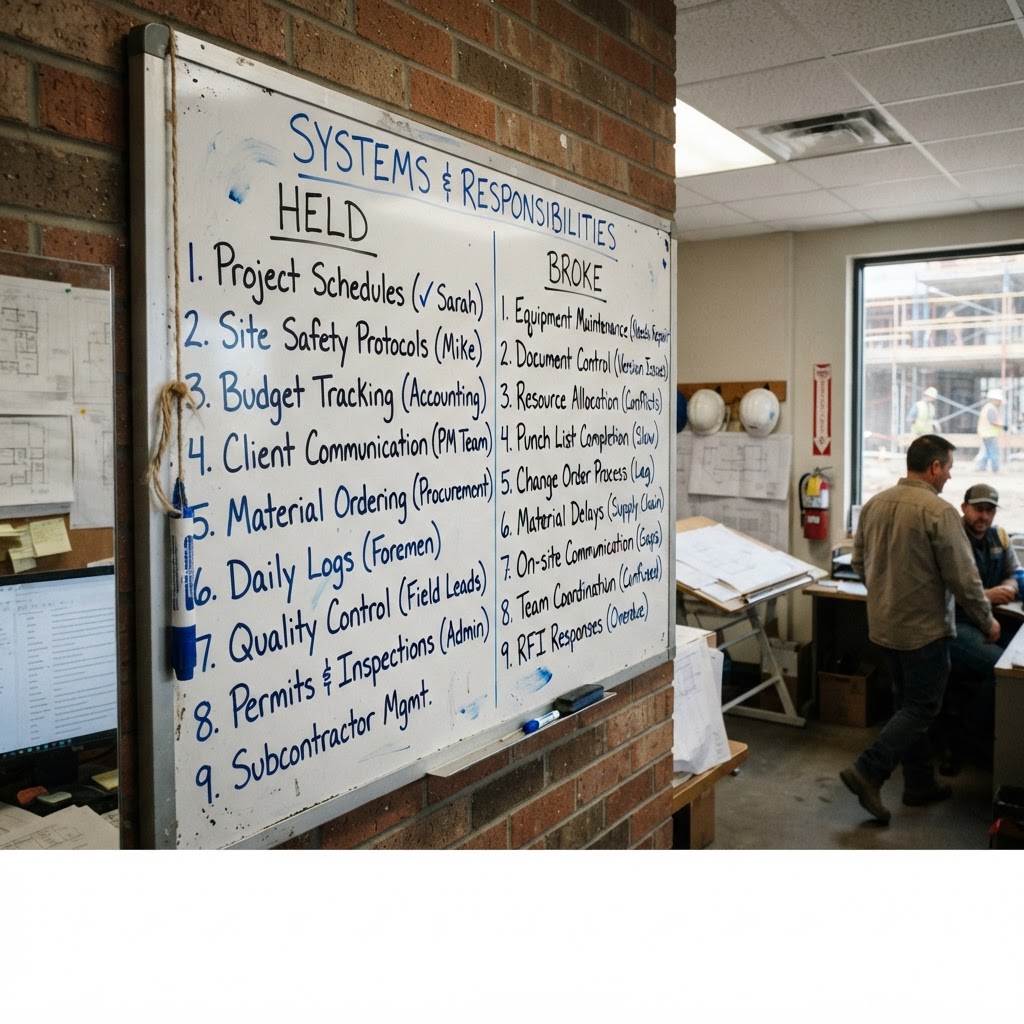
A properly run vacation delegation experiment usually reveals:
-
Hidden leaders.
You find out who naturally steps up, who stays steady under pressure, and who quietly takes ownership without fanfare. -
Fragile processes.
You see which parts of your operation only work because you personally patch gaps in real time. -
Unclear authority.
You find out where the team wasn’t sure who should decide what, and where people made assumptions that don’t match your intent. -
Owner habits that need to change.
You see where you’ve trained the company to depend on micro-decisions from you that should live elsewhere.
This isn’t about judging the team.
It’s about finally seeing the business without your constant intervention.
Coaching Off the Back of the Experiment
Once the experiment is complete, the real coaching work begins.
We usually focus on three lanes:
Lane 1 – Systems That Need Repair
Anywhere the business clearly wobbled, we ask:
- Was this a process gap, a training gap, or an authority gap?
- What specific SOP, checklist, or role clarification would prevent this next time?
We pick a small number of high-leverage fixes instead of trying to repair everything.
Lane 2 – Leaders Who Need More Authority
We look at the people who showed up strong and ask:
- What decisions should they own full-time, not just when you’re gone?
- What training or support do they need to carry that authority well?
- How do we communicate this change to the rest of the team?
We’re turning temporary heroics into permanent structure.
Lane 3 – Owner Identity Shifts
We talk frankly about:
- Where you had the urge to jump in and didn’t.
- Where you did jump in and realized you didn’t need to.
- What it felt like to see the business run without you in the center.
This is often where the biggest growth happens.
You start moving from:
- "I am irreplaceable."
- to "My team can carry the work if I build the right structure and trust them to use it."
Why This Is Better Than Another "Leadership Retreat"
There’s nothing wrong with a nice retreat.
But most leadership retreats live in the world of ideas:
- Big visions.
- Inspiring slogans.
- Abstract commitments.
A vacation delegation experiment is different.
It’s grounded in:
- Real jobs.
- Real clients.
- Real decisions.
You’re not imagining what it would be like to have a business that runs without you.
You’re testing it.
That makes the coaching concrete:
- We’re not guessing where the bottlenecks are – we’ve seen them.
- We’re not guessing who your future leaders are – they just showed us.
- We’re not guessing what systems need tightening – they just broke in front of us.
How We Run These Experiments Inside Groundworks
When we build a vacation delegation experiment with a client, we treat it like a project, not a wish.
A typical arc looks like:
- Session 1 – Mapping Owner Involvement: We put your current reality on the table: where you’re serving as the default problem-solver and decision-maker.
- Session 2 – Designing the Delegation Plan: We build the worksheets, clarify roles, and script your pre-vacation conversation with the team.
- During Vacation – Light Touch Check-ins: We agree ahead of time what counts as an emergency and what doesn’t. You stick to it.
- Session 3 – Debrief: You and your key people tell the story of what happened. We capture wins, failures, and surprises.
- Session 4 – Implementation: We pick a small number of changes in systems, roles, and authority – and lock them in.
This isn’t just about rest.
It’s about taking one of the scariest questions in your head:
"Can this business run without me?"
…and turning it into a structured experiment with real learning.
If you’re tired of half-vacations and you’re ready to see what your business can really do when you step back on purpose, that’s the kind of work we do inside Groundworks.
We don’t ask you to trust blindly.
We design an experiment that shows you, in your own company, whether your systems and team can carry the weight.
And then we coach the next version of your leadership from there.