
A lot of residential construction owners carry a big number in their head.
You might say it like this:
"We’re at around $4M now. I can see $25M–$50M in the future. I just don’t know how to get there without blowing up quality or my life."
That’s not just a revenue target.
It’s a question about identity, structure, and systems.
In this blog, I want to walk through five inflection points between $4M and $25M that we coach residential firms through.
We’ll talk less about "hustle" and more about what actually has to change – inside you, inside your org chart, and inside your processes – for that number to be possible without wrecking the company.
Inflection Point 1: From Irreplaceable Builder to Builder of Builders
At ~$4M, the company usually still revolves around the owner’s personal craftsmanship and judgment.
You:
- Personally rescue jobs when they drift.
- Personally handle the highest-value clients.
- Personally approve key estimates and design or scope decisions.
It feels responsible.
But at $25M, that model breaks.
You can’t be the hero on every job.
The first inflection point is identity:
- From: "I am the irreplaceable builder."
- To: "I build the systems and people that carry our craft."
Coaching at this stage focuses on:
- Delegation experiments that prove your team can carry more than you’ve been allowing.
- Naming and challenging the beliefs that keep you glued to every project.
- Designing your own role around building builders, not just building houses.
Until that identity shift begins, every structural change will snap back to "owner saves the day."
Inflection Point 2: From Informal Roles to a Real Org Chart
At $4M, roles are often fuzzy:
- People wear multiple hats.
- Titles don’t match actual responsibilities.
- Authority moves based on who’s in the room.
You can get away with that for a while.
At $25M, it turns into chaos.
You need a real org chart that:
- Names departments clearly (Design/Precon, Sales, Construction/Operations, Finance/Admin).
- Defines who owns what – not just tasks, but decisions.
- Makes it obvious where a problem belongs when it shows up.
Coaching work here includes:
- Mapping your current reality: who actually does what today.
- Correcting misaligned titles (for example, your culture/ops leader is not your CFO).
- Designing a chart that can carry more volume without turning every issue into "ask the owner."
That chart isn’t just for show.
It becomes the backbone for how you hire, train, and delegate as you scale.
Inflection Point 3: From Heroic Problem-Solving to Protected Processes
At $4M, you can "wing it" on process because you’re close enough to catch most issues.
You fix things by:
- Jumping into jobs personally.
- Rerunning estimates yourself.
- Making one-off exceptions to keep clients happy.
At $25M, that becomes impossible.
You need protected processes – ways of working that:
- Are mapped clearly.
- Have owners (senseis) who guard them.
- Survive staff changes, growth sprints, and vacations.
We often start with one high-friction process, such as:
- Lead intake and qualification for residential projects.
- Pre-construction walkthrough and documentation.
- Change order management and communication.
We use tools like SIPOC (Suppliers, Inputs, Process, Outputs, Customers) to:
- Put the process on paper.
- Identify the biggest friction point.
- Build one strong SOP the team owns.
Coaching helps you:
- Shift from "I’ll just fix it" to "Let’s fix the process so no one has to keep fixing it alone."
Protected processes are how you keep quality and sanity intact while revenue climbs.
Inflection Point 4: From Ad Hoc Tech to Intentional Tools and AI
At $4M, your tech stack is often a patchwork:
- A project management app here.
- A scheduling tool there.
- Maybe an AI chat window or two for ideas.
It works, but it’s not intentional.
At $25M, you can’t afford tool chaos.
You need a tech and AI plan that:
- Matches your processes, not just market hype.
- Uses Copilot or similar tools for workflow tasks (emails, notes, retrieval) where they’re strong.
- Uses reasoning models (Claude/ChatGPT) where thinking support matters – SOPs, org design, scenario planning.
Coaching focuses on:
- Identifying where tools are actually helping vs where they’re adding noise.
- Putting guardrails around AI so it supports judgment without replacing it.
- Sequencing tool adoption so your team doesn’t drown in "yet another app."
The aim is simple:
Tech should extend your systems, not patch over a lack of them.
Inflection Point 5: From Owner-Centered Culture to Team-Owned Standards
At $4M, culture often lives in your personality.
- How you show up.
- How you talk to clients.
- How you handle stress.
People know "how we do things here" because they know you.
At $25M, that’s not enough.
You need team-owned standards:
- Clear definitions of "what good looks like" in design, pre-construction, build quality, and client communication.
- Shared language around delegation, accountability, and problem-solving.
- Leaders beyond you who can enforce and embody those standards.
Coaching helps you:
- Identify your culture protectors – the operations/culture leaders who naturally guard how work feels.
- Give them the authority to shape systems, not just absorb the consequences.
- Create recurring spaces where standards are named, refined, and reinforced.
This is where your business becomes a place people build careers, not just jobs.
Coaching the Journey From $4M to $25M
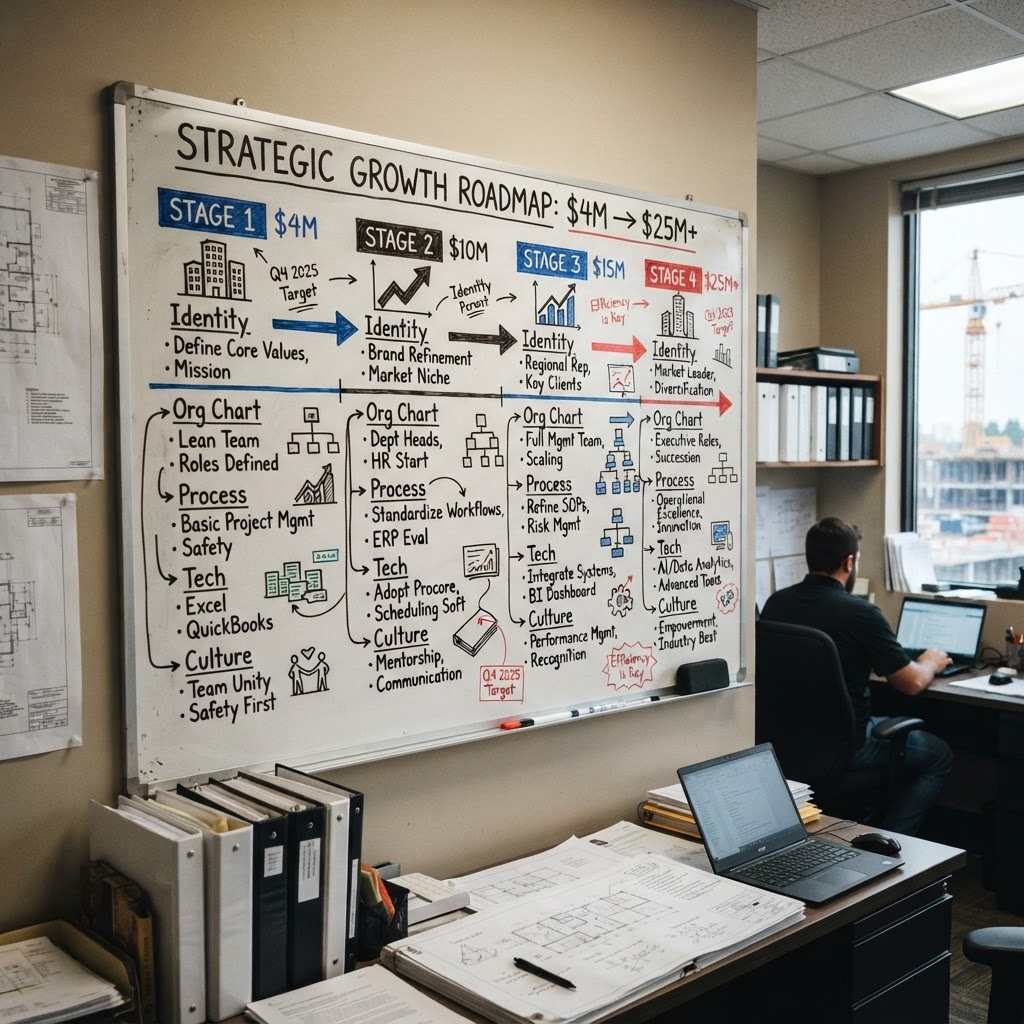
The jump from $4M to $25M isn’t a straight line.
It’s a series of identity shifts, structural shifts, and process shifts.
Inside Groundworks, we don’t throw a generic "scale blueprint" at you.
We:
- Start with your reality – your team, your clients, your current constraints.
- Identify which inflection point is actually live for you right now.
- Build experiments and structures that move that point forward without blowing everything up.
Sometimes that means:
- Coaching you out of the irreplaceable builder identity.
- Rewriting the org chart so your culture/ops leader is in the right seat.
- Running a focused process-mapping engagement on one high-friction workflow.
- Designing a sane tools and AI plan that fits your risk tolerance.
You don’t have to figure all five points out at once.
You have to be willing to see where you’re stuck, and to lead differently at the next turn.
If you’re sitting at $4M–$5M in residential construction, seeing a much bigger company in your mind’s eye, and you’re honest enough to say, "I don’t know how to get there without breaking something," that’s not a weakness.
That’s the beginning of real leadership.
The work we do together is about turning that honesty into a playbook that fits your company, not just the internet’s idea of scaling.