When contractors hear "Lean" or "Six Sigma," most think the same thing:
"Sounds complicated. Sounds corporate. Sounds like something a big factory does, not my company."
You’re not wrong.
A lot of Lean/Six Sigma work has been delivered in ways that feel heavy, abstract, and disconnected from day-to-day construction reality.
But the underlying idea – protect your best processes so they survive growth, new hires, and vacations – is exactly what you need as you scale.
In this blog, I want to give you a minimalist way to start:
One process.
One friction point.
One team-owned SOP.
No jargon. No eight-month consulting project.
Just a focused, 30-day engagement that gives you one stronger way of working your team owns.
Why Process Mapping Matters More Than Another Tool
Most construction companies try to fix problems with tools first:
- A new project management app.
- A new scheduling system.
- A new AI assistant.
But if the underlying process is unclear or broken, tools just help you do the wrong thing faster.
Process mapping flips the order:
- First: See how the work actually flows today.
- Then: Decide how it should flow.
- Then: Choose tools that support that flow.
It’s not about drawing pretty diagrams.
It’s about:
- Making invisible steps visible.
- Naming where friction lives.
- Creating a shared picture so the team can improve it together.
Step 1: Pick One Process That Hurts the Most
You do not start by mapping your entire company.
You start with one process that costs you the most:
- The one that eats hours every week.
- The one that produces the most rework.
- The one that frustrates your best people.
Examples:
- Kitchen design handoff from sales to operations.
- Pre-construction site walkthrough and documentation.
- Change order intake and pricing.
Ask your team:
- "If we could fix just one way of working to save time and headaches, what would it be?"
That’s your candidate process.
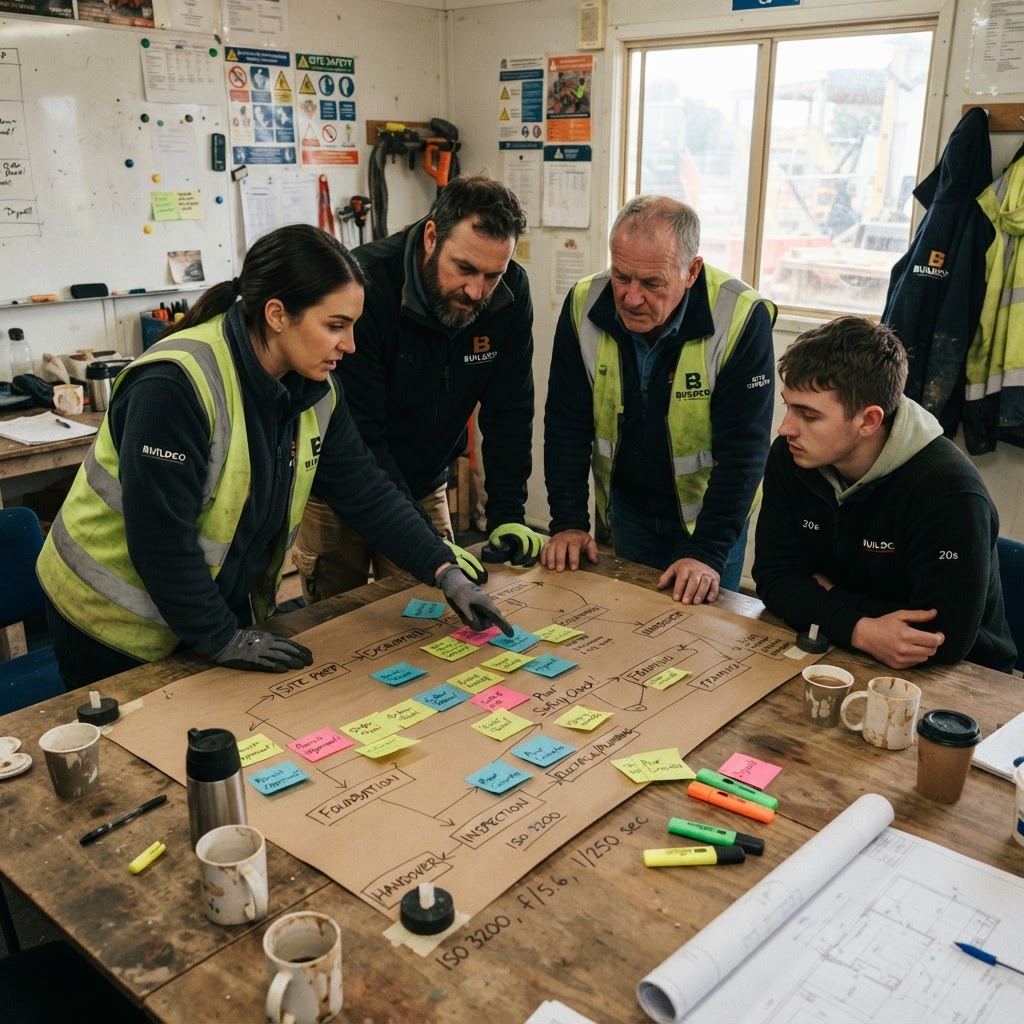
Step 2: Map the Process Together (SIPOC Style)
Now we sit down and map it.
Not alone in your office.
With the people who live this process every day.
We use a simple SIPOC frame:
- Suppliers: Who or what feeds this process? (Leads, designers, estimators, client inputs.)
- Inputs: What comes into the process? (Plans, specs, photos, budgets.)
- Process: What are the key steps, in order? (We keep it high-level, 5–10 steps.)
- Outputs: What should come out of the process every time? (Signed-off scope, estimate, clean handoff package.)
- Customers: Who depends on this output being right? (Clients, field crews, subs, accounting.)
We capture:
- What actually happens today.
- Where things skip or loop back.
- Where people improvise because the flow isn’t clear.
This isn’t about blame.
It’s about seeing the reality everyone has been working around.
Step 3: Name One Friction Point to Fix
Once the process is on paper, the temptation is to fix everything.
We don’t.
We ask:
- "If we could fix just one pain point in this process, which one would change the game the most?"
Examples:
- The handoff between sales and design is sloppy – half the information is missing or unclear.
- The site walkthrough checklist is inconsistent – every lead does it differently.
- Change orders are entered late or inconsistently – accounting is always chasing data.
We circle one friction point.
That’s where we focus.
Step 4: Build One Team-Owned SOP Around That Friction Point
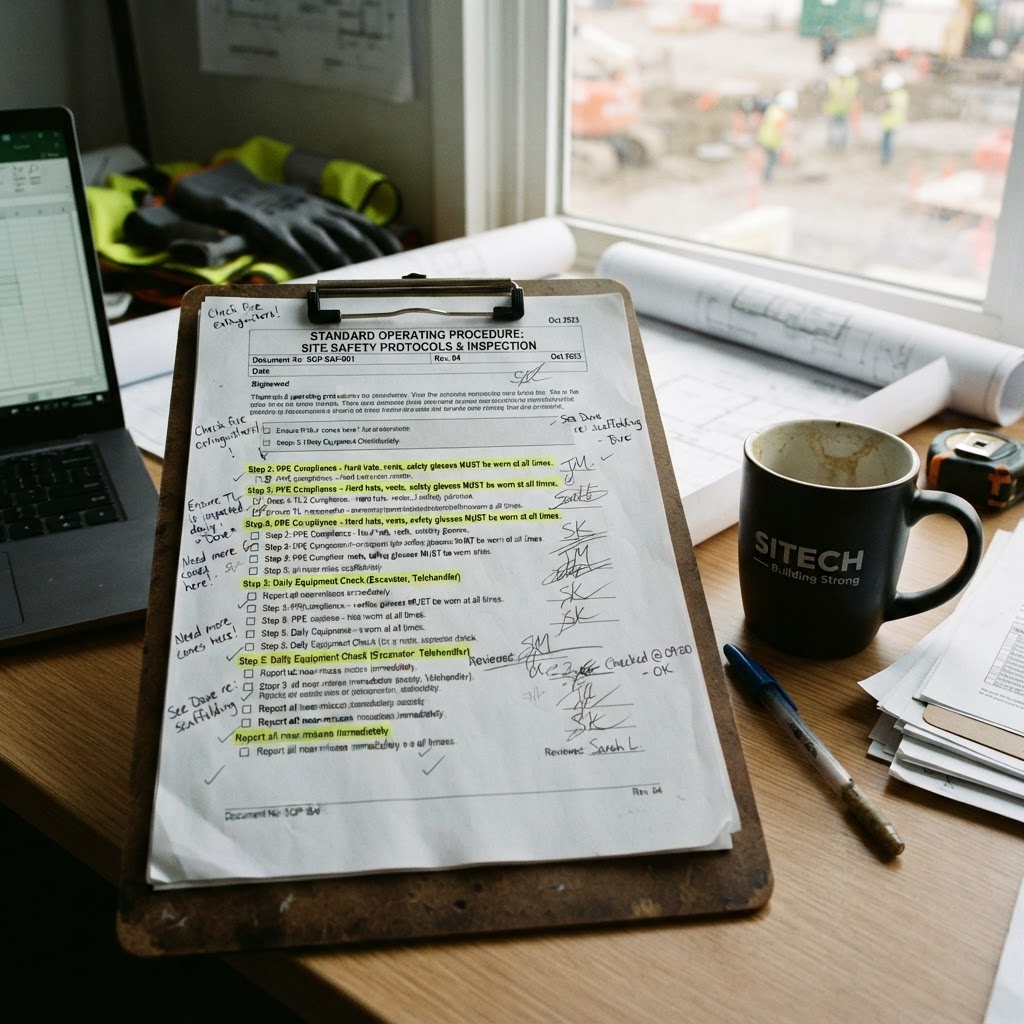
Now we design a way of working that protects that vulnerable point.
We:
- Bring the people who touch that step together.
- Ask them what "good" looks like and what usually goes wrong.
- Draft a simple SOP in plain language.
For example, for a sales-to-design handoff SOP, we might define:
- The minimum information required before design can start.
- The format of that information (photos, measurements, client notes).
- Who is responsible for creating and checking the handoff package.
Key rules:
- The SOP is built with the team, not imposed on them.
- The language matches field reality, not consultant jargon.
- The first draft is tested, not worshipped.
We then:
- Pilot the SOP on a few live jobs.
- Collect feedback from the people using it.
- Adjust where it doesn’t fit reality.
At the end, we have one solid SOP that:
- Protects the high-friction step.
- Has visible owners.
- Lives in a place the team can actually access.
Step 5: Lock In Ownership and Rhythm
The last step is making sure this doesn’t become "another document" that fades away.
We:
- Name a process owner (sensei) for this SOP – the person responsible for keeping it real and updated.
- Schedule a simple 30–60 day review: "Is this SOP working? What needs to change?"
We also agree on:
- Where the SOP lives (shared drive, app, printed in the shop).
- When it’s used (onboarding, job kickoffs, handoffs).
The goal is for this SOP to become:
- Part of how you actually run the business.
- Not just a file attached to an email once and then forgotten.
Why We Start This Small on Purpose
You could hire someone to do a full Lean Six Sigma roll-out.
For most contractors, that’s overkill.
You don’t need a new religion.
You need proof that:
- Mapping a process together is useful.
- Focusing on one friction point can produce real change.
- Team-owned SOPs can stick.
Once you’ve seen that work on one process, you can:
- Repeat it on another.
- Build a small library of living SOPs over time.
- Bring in more advanced tools later if they actually add value.
We start small because:
- Your people are busy.
- You don’t have time or appetite for big theory.
- You need wins that make sense in the field.
How We Run This Minimalist Engagement Inside Groundworks
When we help a client do "one process, one friction point, one SOP," we treat it like a contained, high-impact sprint.
A typical 30-day engagement looks like:
- Week 1 – Process Selection & Mapping: We pick the process that hurts the most and map it with your team using SIPOC.
- Week 2 – Friction Selection & SOP Draft: We choose one friction point and draft the SOP with the people who live it.
- Week 3 – Pilot & Feedback: We run the SOP on live work, gather feedback, and capture where reality diverges from the draft.
- Week 4 – Adjust & Lock In: We refine the SOP, name the owner, and decide when and where it’s used.
At the end, you walk away with:
- One process that is clearly mapped.
- One friction point that is genuinely improved.
- One SOP your team helped build and actually uses.
That might not sound glamorous.
But if you pick the right process, it can:
- Save hours every week.
- Reduce mistakes and rework.
- Lower stress for both you and your crew.
If you’ve been curious about "Lean" or "better processes" but turned off by the complexity, this is your entry point.
You don’t have to become a black belt.
You have to be willing to say:
"Let’s put our best process on paper so it survives the next growth sprint, the next new hire, or the next vacation."
That’s the work we do together.